.png)
.png)


An Expert Buyer’s Guide to the Parker Torqmotor: 3 Critical Steps for 2026
diciembre 31, 2025
Resumen
The Parker Torqmotor stands as a significant component within the domain of low-speed, high-torque (LSHT) hydraulic motors, distinguished by its orbital Gerotor/Geroller design. This document examines the operational principles, key design variations, and critical selection methodology for the Parker Torqmotor series as of 2026. It analyzes the conversion of hydraulic energy—fluid pressure and flow—into mechanical rotational energy, focusing on the internal mechanics that generate substantial torque at low rotational speeds. The primary distinction between different series, such as the TE and TK, is investigated, highlighting differences in bearing configurations, pressure capacities, and shaft load capabilities, which dictate their suitability for specific industrial, mobile, and agricultural applications. The analysis provides a structured framework for engineers and technicians to correctly specify a Parker Torqmotor by evaluating application demands, comparing series specifications, and performing accurate sizing calculations. This process ensures optimal system performance, efficiency, and operational longevity while mitigating the risk of premature failure due to misapplication in demanding environments like mining, construction, and forestry.
Principales conclusiones
- Begin selection by defining your application's required torque and speed.
- The Parker Torqmotor TK series offers superior durability for high side-load applications.
- Geroller-style motors provide smoother operation and longer life than Gerotor types.
- Match the motor's displacement to achieve the desired speed with available flow.
- System pressure and motor displacement directly determine output torque.
- Properly size your hydraulic system to prevent motor damage and ensure efficiency.
- Always protect the motor with appropriate filtration and pressure relief valves.
Índice
- Understanding the Hydraulic Universe: The Foundation of Motion
- Step 1: Diagnosing Your Application's True Needs
- Step 2: Selecting the Precise Parker Torqmotor for the Task
- Step 3: Sizing, Integration, and Safeguarding Your Investment
- Preguntas más frecuentes (FAQ)
- A Concluding Thought on Mechanical Symbiosis
- Referencias
Understanding the Hydraulic Universe: The Foundation of Motion
Before we can begin the thoughtful process of selecting a specific component like a Parker Torqmotor, it is profoundly important that we first establish a shared understanding of the world it inhabits. Imagine a hydraulic system not as a collection of inert metal parts, but as a living circulatory system for a machine. In this system, hydraulic fluid is the lifeblood, the pump is the heart, and the actuators—cylinders and motors—are the muscles that perform the work. The principles governing this system are both elegant and powerful, and a grasp of them transforms the task of selection from a simple matching of numbers to a deep, reasoned judgment.
A hydraulic motor is a device that performs a fascinating energy conversion. It takes the potential and kinetic energy stored within a moving fluid (hydraulic energy) and translates it into rotational mechanical energy (torque and speed) [GlobalSpec, 2025]. This is the direct inverse of a hydraulic pump's function. A pump, often an bomba hidráulica eléctrica, takes mechanical energy from an engine or electric motor and imparts it to the fluid, creating flow and enabling the build-up of pressure. The motor receives this energized fluid and uses it to turn a shaft, which can then drive a wheel, a winch, a conveyor, or any number of other implements.
The relationship between pressure and flow is fundamental. Think of a simple garden hose. The amount of water coming out of the hose per minute is the flow rate. The force with which it sprays is related to the pressure. If you partially block the end of the hose with your thumb, you restrict the flow's path, causing the pressure to build up behind your thumb and the water to spray out with much greater force.
In a hydraulic system:
- Flow (Liters per Minute or Gallons per Minute) dictates the speed of the actuator. More flow to a hydraulic motor means its shaft will spin faster.
- Pressure (Bar or PSI) dictates the force or torque. Pressure arises when the fluid's flow encounters resistance. This resistance is the load you are trying to move. To lift a heavier weight with a hydraulic cylinder or turn a winch against a greater load with a hydraulic motor, the system pressure must increase to overcome that resistance (Blince, 2025).
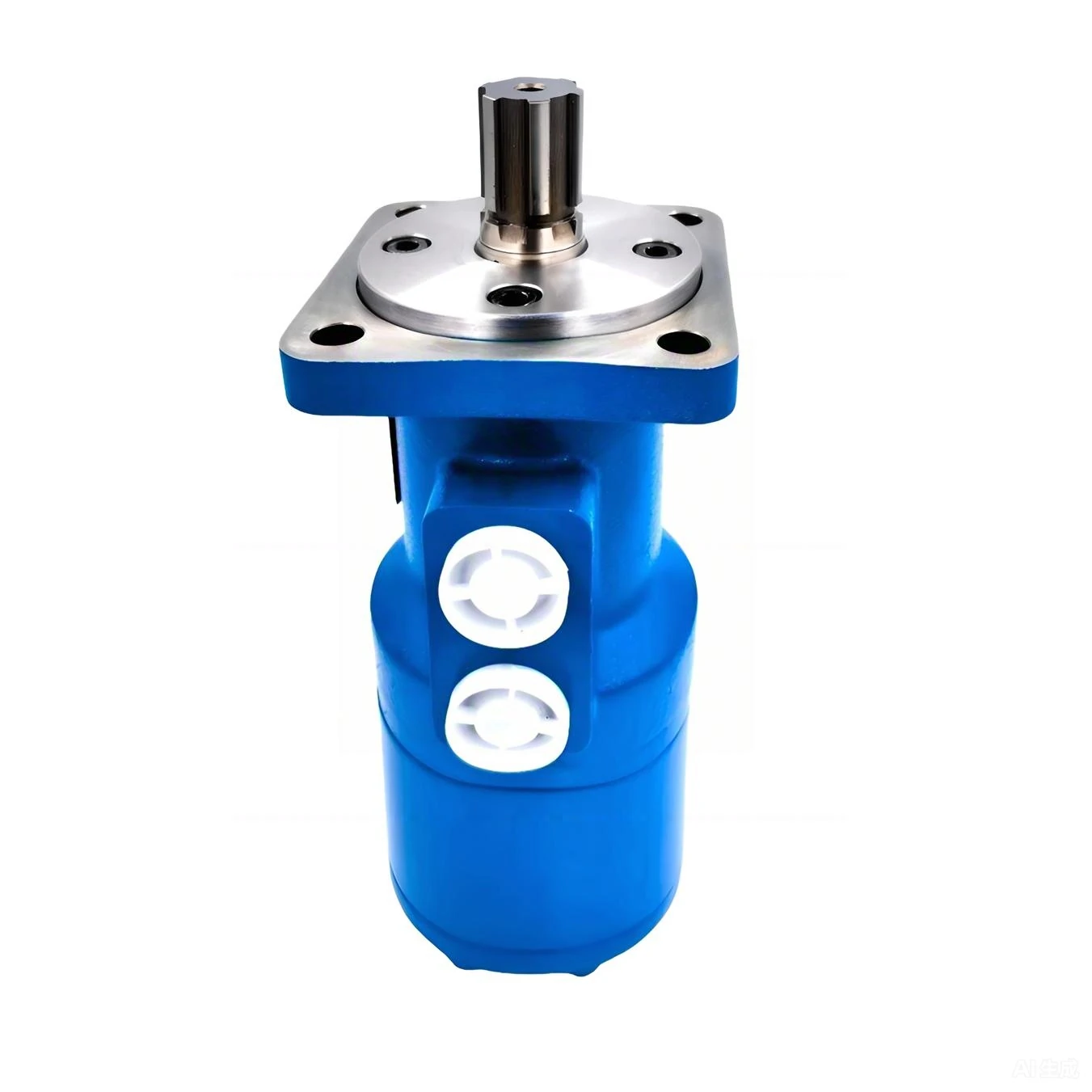
The Parker Torqmotor belongs to a specific and important class of motores hidráulicos known as Low-Speed, High-Torque (LSHT) motors. As the name suggests, their specialty is producing a very large amount of twisting force (torque) at relatively slow rotational speeds. This makes them fundamentally different from, say, an electric motor that might spin at thousands of RPM but produce very little direct torque without a massive gearbox. LSHT motors are the workhorses, the powerlifters of the hydraulic world, ideal for applications where brute force is more important than high speed. The specific design that allows the Parker Torqmotor to achieve this remarkable feat is the "orbiting Gerotor" or "Geroller" principle, which we will explore in great detail.
Step 1: Diagnosing Your Application's True Needs
The most common and costly mistake in hydraulic system design is not a calculation error but a failure of imagination and diagnosis at the very beginning. Before you even look at a catalog or a specification sheet for a Parker Torqmotor, you must become a detective and a physician for your application. You must ask not just "what" it needs to do, but "how," "how often," and "under what conditions." The ideal motor is not merely one that works, but one that is in harmony with the demands placed upon it, ensuring a long and efficient service life (Gannon, 2015).
The Four Pillars of Application Analysis
Every application, whether it's a salt spreader on a winter maintenance vehicle in Russia, a sugarcane harvester in Southeast Asia, or a mining conveyor in South Africa, can be broken down into four critical areas of inquiry.
-
Load Characteristics: This goes beyond a single number. What is the nature of the force the motor must overcome?
- Starting vs. Running Torque: Is the heaviest work done when starting from a standstill (high starting torque), like breaking a heavy load free on a winch? Or is the load relatively constant once moving (running torque), like driving a fan? Piston motors often have excellent starting torque, but the Geroller design of a Parker Torqmotor also provides very good performance in this area.
- Shock Loads: Will the motor experience sudden, violent impacts? Consider the drive wheel of a skid steer loader hitting a rock, or a brush cutter blade striking a thick root. The motor's internal construction, bearings, and shaft must be robust enough to absorb these shocks without failing.
- Duty Cycle: How often will the motor be working? Is it continuous, 24/7 operation like on a factory conveyor, or intermittent, like the auger on a feed wagon used for a few hours a day? A continuous, high-pressure duty cycle generates more heat and places more stress on the components, often warranting a more robust motor selection.
-
Speed Requirements: How fast does the work need to be done?
- Maximum and Minimum Speed: What is the full range of operational speeds? Some applications require a steady, constant speed, while others need to vary.
- Speed Smoothness: Is smooth, "cog-free" rotation critical, especially at very low speeds? This is a key advantage of orbit hydraulic motors like the Parker Torqmotor. The multiple fluid chambers pushing on the rotor provide a much smoother output than a simple gear motor, which can feel "notchy" at low RPM. This is crucial for applications like vehicle propulsion or precision positioning systems.
-
Physical and Environmental Constraints: Where will this motor live and what will it endure?
- Space Envelope: How much physical space is available? The Parker Torqmotor TE series, for example, is known for its compact size, making it ideal for tight installations. Some applications might require a "wheel motor" configuration, where the mounting flange and shaft are designed to be integrated directly into a wheel hub.
- Ambient Temperature: Will the motor operate in the extreme heat of a Middle Eastern desert or the freezing cold of a Siberian winter? High temperatures can degrade hydraulic fluid and seals, while extreme cold can make the fluid thick and sluggish. You must select seals (like Viton vs. standard NBR) and hydraulic fluid appropriate for the temperature range.
- Contaminación: What is the operating environment like? Is it a dusty agricultural field, a gritty construction site, or a corrosive marine environment? Contamination is the number one enemy of any hydraulic system. While gear motors are often cited as being more resistant to contamination, the robust design of a Parker Torqmotor, when paired with proper system filtration, delivers excellent reliability (Caterpillar, 2021).
-
System Power Source: What is driving the system?
- Available Flow: The hydraulic pump (the "heart" of the system) has a maximum flow rate it can produce at a given engine or motor speed. This available flow is the ultimate constraint on the motor's potential speed.
- Available Pressure: The pump's pressure relief valve sets the maximum system pressure. This determines the maximum possible torque the motor can generate. You cannot demand more torque from a motor than the system's pressure setting will allow.
Imagine you are designing a drive system for a small tracked vehicle. You would need to consider the vehicle's weight, the steepest grade it must climb (which determines the running torque), the force needed to get it moving from a stop (starting torque), the potential for the tracks to hit obstacles (shock loads), the desired top speed (which sets the flow requirement), and the physical space available for the motors. A thorough diagnosis like this is the first and most critical step.
Step 2: Selecting the Precise Parker Torqmotor for the Task
Once you have a deep and nuanced portrait of your application's demands, you can approach the Parker Torqmotor catalog with the confidence of an expert. You are no longer just looking for a part that fits; you are searching for the perfect mechanical partner for the job. The Parker Torqmotor family is extensive, but for most applications, the choice often comes down to a few key series, primarily the TE, TG, and TK series. Understanding the subtle but critical differences between them is the key to a successful selection.
At the heart of every Parker Torqmotor is the Gerotor or Geroller element. This is the ingenious mechanism that converts fluid pressure into rotation.
- Gerotor: This consists of a fixed outer ring with internal teeth and a rotating inner "star" gear with one fewer tooth. As pressurized fluid is directed into the expanding chambers created between these two parts, it forces the inner star to orbit and rotate, turning the output shaft.
- Geroller: This is an evolution of the Gerotor principle. Instead of solid teeth, the outer ring contains cylindrical rollers. As the inner star rotates, it pushes against these rollers. This replaces sliding friction with rolling friction, which is significantly more efficient. The benefits are substantial: lower friction means less wasted energy (better mechanical efficiency), less heat generation, and a much longer service life, especially under high-pressure conditions. For most demanding applications in 2026, the Geroller design is the superior choice.
Comparing the Workhorse Series: TE vs. TG vs. TK
While Parker offers several other specialized series, the TE, TG, and TK represent the core of the lineup and cover a vast range of applications. Their primary differences lie in their internal construction, specifically their bearings and their ability to handle pressure and side loads.
| Característica | Parker Torqmotor TE Series | Parker Torqmotor TG Series | Parker Torqmotor TK Series |
|---|---|---|---|
| Primary Design | Geroller | Geroller | Geroller |
| Bearing Type | Journal Bearings | Journal Bearings | Needle/Tapered Roller Bearings |
| Pressure Capacity | Standard Duty (Lower) | Standard/Heavy Duty (Medium) | Heavy Duty (Highest) |
| Side Load Capacity | Low to Moderate | Moderado | High to Very High |
| Relative Cost | $ | $$ | $$$ |
| Common Application | Light-duty conveyors, augers, food processing, light mobile use | General purpose mobile & industrial, sweepers, mowers, winches | Wheel drives, heavy conveyors, drilling rigs, high shock-load environments |
Let's dissect this comparison to understand its practical implications.
The Parker Torqmotor TE Series: The Compact Specialist
Think of the TE series as the agile and compact member of the family. Its defining feature is its use of journal bearings to support the output shaft. Journal bearings are simple, sleeve-like bearings where the shaft rotates within a lubricated sleeve. They are very compact and cost-effective. However, they have a limited ability to handle side loads (radial forces).
What is a side load? Imagine a motor with a belt pulley on its shaft. The tension of the belt is constantly pulling the shaft to one side. This is a side load. A motor directly coupled to a gearbox experiences very little side load. A motor used as a wheel drive, bearing the weight of the vehicle, experiences a very high side load.
The TE series is therefore ideal for applications where the motor is coupled directly to the load or where side loads are minimal. Its compact size makes it a fantastic problem-solver in tight spaces. You will often find it on:
- Small agricultural augers
- Light-duty conveyors
- Food processing equipment
- Spreader discs on salt or fertilizer spreaders
The Parker Torqmotor TG Series: The Versatile All-Rounder
The TG series is often considered the workhorse of the Torqmotor line. It also uses journal bearings but features a more robust housing and internal components, allowing it to handle higher operating pressures and moderate side loads compared to the TE series. It has a larger displacement range, meaning it can produce higher torque values. The TG series hits a sweet spot of performance, durability, and cost that makes it suitable for an enormous range of applications. It is perhaps the most common Parker Torqmotor you will encounter in the field, powering everything from:
- Skid steer attachments
- Industrial sweepers and scrubbers
- Turf equipment and mowers
- Medium-duty winches
The Parker Torqmotor TK Series: The Heavy-Duty Champion
The TK series is the undisputed heavyweight champion. Its key distinguishing feature is its use of roller bearings instead of journal bearings. These bearings (often tapered roller bearings) are specifically designed to handle immense side loads and shock loads. They replace the sliding friction of a journal bearing with the rolling friction of high-strength steel rollers, dramatically increasing the motor's durability and lifespan in harsh applications.
This makes the TK series the only choice for applications with significant overhung loads or where the motor itself is a structural, load-bearing component. The additional cost of the TK series is an investment in reliability and the prevention of catastrophic failure. You should specify a TK series for:
- Wheel Drives: For any vehicle where the wheel is mounted directly to the motor shaft.
- Heavy-Duty Conveyor Drives: Especially those using a chain and sprocket, which imparts a high side load.
- Drilling and Boring Equipment: Such as auger drives for ground drilling or post-hole digging.
- Powerful Winch Drives: Where the cable drum is supported by the motor shaft.
By carefully considering the nature of the load—especially the presence of side loads—you can make an informed decision between these core series, ensuring you are not over-paying for a heavy-duty motor you don't need, nor under-specifying a lighter-duty motor that is destined for premature failure.
Step 3: Sizing, Integration, and Safeguarding Your Investment
With a clear understanding of your application and the ideal Parker Torqmotor series, we arrive at the final step: the precise science of sizing and the art of successful system integration. This is where we translate our qualitative analysis into quantitative calculations to ensure the motor performs as expected and is protected from harm.
The Mathematics of Motion: Sizing Your Motor
The three key performance variables of a hydraulic motor are speed, torque, and power. They are interconnected through a set of straightforward formulas. Let's walk through them as a thoughtful engineer would.
Calculating Rotational Speed (RPM)
The speed of your motor is a direct function of the hydraulic fluid flow rate supplied to it and its own displacement. Displacement is the volume of fluid the motor requires to turn its shaft one full revolution. It is typically measured in cubic centimeters per revolution (cc/rev) or cubic inches per revolution (in³/rev).
The basic formula is: Speed (RPM) = (Flow Rate (Liters/min) × 1000) / Displacement (cc/rev)
Let's consider a practical example. You have a hydraulic system powered by an electric hydraulic pump that provides a constant 30 liters per minute (LPM) of flow. You are considering a Parker Torqmotor with a displacement of 160 cc/rev.
Speed = (30 LPM × 1000) / 160 cc/rev = 187.5 RPM
This is the theoretical speed. In reality, no motor is 100% efficient. A small amount of fluid will always leak internally from the high-pressure side to the low-pressure side without doing useful work. This is accounted for by the motor's volumetric efficiency, which is usually around 90-98%.
Actual Speed = Theoretical Speed × Volumetric Efficiency
If our 160cc motor has a volumetric efficiency of 95% (0.95), the actual speed would be: Actual Speed = 187.5 RPM × 0.95 = 178 RPM (approx.)
This distinction is vital. When you need a precise output speed, you must account for efficiency to select the correct displacement.
Calculating Output Torque (Nm)
Torque is the twisting force the motor can produce. It is determined by the pressure drop across the motor and the motor's displacement. The pressure drop is the difference between the inlet pressure and the outlet pressure. In many systems, the outlet (return line) pressure is very low, so the inlet pressure is a close approximation of the pressure drop.
The theoretical formula is: Torque (Nm) = (Pressure Drop (bar) × Displacement (cc/rev)) / (20 × π)
Let's continue with our example. Your system's relief valve is set to 175 bar. You need to power a winch that requires 400 Nm of torque to start moving its load. Will the 160 cc/rev Parker Torqmotor be sufficient?
Theoretical Torque = (175 bar × 160 cc/rev) / 62.83 = 445.6 Nm
This looks promising! But again, we must consider efficiency. Just as some fluid leaks internally, some energy is lost to friction within the motor's moving parts. This is accounted for by mechanical efficiency.
Actual Torque = Theoretical Torque × Mechanical Efficiency
If the motor's mechanical efficiency is 90% (0.90): Actual Torque = 445.6 Nm × 0.90 = 401 Nm
Our calculated actual torque (401 Nm) is just enough to meet the 400 Nm requirement. This is a perfect illustration of why sizing based on theoretical numbers alone is dangerous. It's always wise to select a motor that exceeds the requirement by a safe margin (e.g., 15-25%) to account for pressure drops in hoses, fluid temperature changes, and general system wear over time.
Calculating Output Power (kW)
Power is the rate at which work is done. In a rotating system, it is a combination of torque and speed.
The formula is: Power (kW) = (Torque (Nm) × Speed (RPM)) / 9550
Using our calculated actual values: Power = (401 Nm × 178 RPM) / 9550 = 7.47 kW
This power calculation is crucial for ensuring the prime mover (the engine or electric motor driving the pump) is capable of supplying the necessary power to the hydraulic system. The overall efficiency of the motor, which is simply volumetric efficiency multiplied by mechanical efficiency, gives a complete picture of how well the motor converts hydraulic input power into mechanical output power.
System Integration: Creating a Harmonious Whole
A Parker Torqmotor, no matter how perfectly selected and sized, cannot function in isolation. It must be integrated into a system of components that support and protect it.
| Component | Function in Relation to the Motor | Critical Consideration |
|---|---|---|
| Bomba hidráulica | Supplies the flow that determines motor speed. | The pump's flow rating must match the speed requirement. An electric hydraulic pump can offer on-demand flow. |
| Pressure Relief Valve | Acts as the system's "safety valve," limiting maximum pressure. | Must be set at or below the motor's maximum continuous pressure rating to prevent catastrophic damage. |
| Directional Control Valve | Directs fluid to the motor's inlet/outlet ports to control direction (forward/reverse). | Must have a flow rating sufficient for the system to avoid creating excessive heat and pressure drops. |
| Filtration | Removes contaminants (dirt, metal particles, water) from the fluid. | Contamination is the leading cause of hydraulic component failure. A proper filtration strategy is non-negotiable. |
| Hydraulic Fluid | Transmits power, lubricates moving parts, and carries away heat. | Must have the correct viscosity for the operating temperature range and be compatible with motor seals. |
| Hoses and Fittings | Transport the fluid between components. | Must be sized correctly to prevent flow restrictions and have pressure ratings that exceed the system's maximum pressure. |
A thought experiment on protection: Imagine your system is running a heavy conveyor. A large object jams the conveyor, causing it to stop instantly. The pump, however, is still trying to force fluid into the now-stalled motor. Without a pressure relief valve, the pressure would spike almost instantaneously to a level that could rupture the motor housing, blow hoses, or damage the pump. The pressure relief valve senses this spike, opens a path for the fluid to return directly to the tank, and saves the entire system from destruction. This illustrates the profound importance of viewing the system as an interconnected whole, where each component has a role in protecting the others.
By following this three-step process—a deep diagnosis of the application, a careful selection of the right series, and precise sizing and integration—you elevate yourself from a parts-picker to a true system architect. You ensure that the Parker Torqmotor you choose will not only perform its function but will do so reliably, efficiently, and safely for years to come.
Preguntas más frecuentes (FAQ)
What is the main difference between a Parker Torqmotor TE and TK series?
The fundamental difference lies in their internal bearing systems. The TE series uses journal bearings, which are compact and cost-effective, making them suitable for applications with low to moderate side loads. The TK series uses robust roller bearings (needle or tapered roller), which are specifically designed to handle high side loads and shock loads. You should choose a TK series for applications like wheel drives or heavy chain-driven systems where the motor shaft supports significant weight or tension.
Can I replace a motor from another brand with a Parker Torqmotor?
Yes, in many cases this is possible and can be an excellent upgrade. The key is to match the critical specifications: displacement (cc/rev or in³/rev), mounting flange type and dimensions, shaft type (e.g., keyed, splined) and diameter, and port type and size. Parker Torqmotor models are often designed with industry-standard mounting options (like SAE A or SAE B flanges) to facilitate such retrofits.
What does "displacement" mean and how does it affect performance?
Displacement is the volume of hydraulic fluid required to turn the motor's shaft one complete revolution. It is the motor's defining size characteristic. For a given flow rate from your pump, a smaller displacement motor will spin faster, while a larger displacement motor will spin slower. For a given system pressure, a larger displacement motor will produce more torque.
Why is my hydraulic motor losing power or speed?
A loss of performance can stem from several issues. Internally, increased leakage past the Geroller set due to wear will reduce volumetric efficiency, causing the motor to slow down under load. Externally, problems often lie elsewhere in the system. A worn pump will produce less flow, reducing motor speed. A faulty pressure relief valve that is opening too early will limit the pressure, reducing available torque. Contaminated fluid can also cause valves to stick and components to wear prematurely.
What is the difference between a Gerotor and a Geroller motor?
Both are types of orbit hydraulic motors. A Gerotor uses a solid, toothed outer ring. A Geroller uses an outer ring with individual rollers that the inner star gear pushes against. The Geroller design replaces sliding friction with more efficient rolling friction. This results in higher mechanical efficiency, less heat generation, smoother low-speed operation, and significantly longer component life, making it the preferred choice for most modern, demanding applications.
How important is filtration for my Parker Torqmotor?
Filtration is arguably the single most important factor in ensuring a long service life for any hydraulic component, including a Parker Torqmotor. Contaminant particles in the hydraulic fluid act like liquid sandpaper, grinding away at the precision-machined internal surfaces. This wear increases internal leakage, reduces efficiency, and can eventually lead to catastrophic failure. Always follow the manufacturer's recommendation for fluid cleanliness levels and use high-quality filters.
What causes a hydraulic motor shaft seal to leak?
A leaking shaft seal is a common symptom with several possible root causes. The most frequent cause is excessive case pressure. The motor's case (the housing) should be connected to a low-pressure return line to the tank. If this line is restricted or blocked, pressure can build up inside the motor housing and force fluid past the shaft seal. Another common cause is excessive side load on a motor not designed for it (e.g., using a TE series where a TK is required), which can deflect the shaft and cause the seal to wear unevenly. Finally, a worn or scored shaft surface can also damage the seal and cause a leak.
A Concluding Thought on Mechanical Symbiosis
The process of selecting a Parker Torqmotor is a compelling exercise in mechanical empathy. It requires us to look beyond the cold numbers of a specification sheet and to understand the life of the machine we are empowering. We must consider the forces it will battle, the environment it will inhabit, and the rhythm of its work. By moving through a logical progression—from diagnosing the need, to selecting the appropriate class of component, to calculating the precise fit—we are not merely assembling a machine. We are fostering a symbiotic relationship between the power source, the actuator, and the work to be done. A well-chosen motor is a quiet partner, performing its duty with strength and endurance, while a poorly chosen one is a source of constant struggle and premature failure. The diligence invested in this selection process pays dividends not just in performance, but in the longevity and reliability that form the bedrock of all great engineering.
Referencias
Blince. (2025, October 20). The role of hydraulic pumps and motors in hydraulic systems. Blince Hydraulics. https://www.blince.com/The-Role-of-Hydraulic-Pumps-and-Motors-in-Hydraulic-Systems-id41414385.html
Caterpillar. (2021, October 29). Cat® hydraulic pumps & motors.
Gannon, M. (2015, October 7). Select the right motor for your hydraulic applications. Mobile Hydraulic Tips. https://www.mobilehydraulictips.com/select-the-right-motor-for-your-hydraulic-applications/
GlobalSpec. (2025, January 1). Hydraulic motor working principle.
Hidraoil. (2024, August 21). Learn about hydraulic motors.
Hidros Group. (2024, August 12). Working principle of hydraulic motors and selection criteria. https://www.hidros.com.tr/working-principle-of-hydraulic-motors-and-selection-criteria/
Mobile Hydraulic Tips. (2017, December 8). What are hydraulic motors?https://www.mobilehydraulictips.com/hydraulic-motors/

