.png)
.png)
.png)

Danfoss-Type VS. Eaton-Type Hydraulic Motors
Dezember 18, 2025
As someone who works closely with electric hydraulic motor, I often get asked this question: What’s the difference between a Danfoss-type motor and an Eaton-type motor?
Both belong to the same family of low-speed, high-torque (LSHT) orbital motors, but their internal designs and performance characteristics are quite different. Here’s a clear comparison based on real technical experience.
1. Structure and Valve Type
Danfoss motors (like OMS, OMT, OMV) use a disc valve system. The oil flow is controlled through a rotating distribution disc, giving high precision in oil distribution.
Eaton motors (like Char-Lynn JH, JS series) use a spool valve system, where the valve is integrated into the output shaft. This makes the structure compact and responsive, especially at low speeds.
2. Rotor Set Design
Danfoss-type motors generally use an insert-type geroler set, with rollers between the rotor and stator. This design reduces friction, increases mechanical efficiency, and improves service life.
Eaton-type motors often use a gerotor set (without rollers). The structure is simpler and cost-effective but creates slightly higher internal friction.
3. Sealing and Back Pressure
Danfoss motors have a high-pressure shaft seal and can operate reliably under high back pressure—even without a drain line.
Eaton motors typically require an external drain port, and their back pressure tolerance is lower. However, they perform very smoothly in low-speed conditions.
4. Efficiency and Torque
Danfoss-type motors offer higher volumetric efficiency and torque density, making them ideal for heavy-duty and continuous high-pressure applications.
Eaton-type motors excel in smooth starting and stable low-speed control, which makes them a good choice for agricultural or light-duty equipment.
5. Typical Applications
Danfoss-type: construction machinery, hydraulic winches, conveyors, drilling rigs, and road equipment.
Eaton-type: agricultural machines, mobile handling systems, light industrial drives, and hydraulic tools.
6. Summary
In short:
Danfoss = High pressure, high torque, long life
Eaton = Smooth control, flexible speed, simple structure
If you’re choosing motors for export or replacement, it’s important to match the internal structure type with the target machine’s design standard. Danfoss-type and Eaton-type motors are not interchangeable in all cases—but understanding their design differences helps you select the best solution for each application.
Below, I will present two sets of appearance images of cycloidal (orbital) hydraulic motors based on the structures from Danfoss and Eaton/Char-Lynn. Afterwards, I will explain some typical differences that can be observed from their external appearance. I hope this will help you visually distinguish these two types of designs during selection, identification, or training.
Danfoss-type:
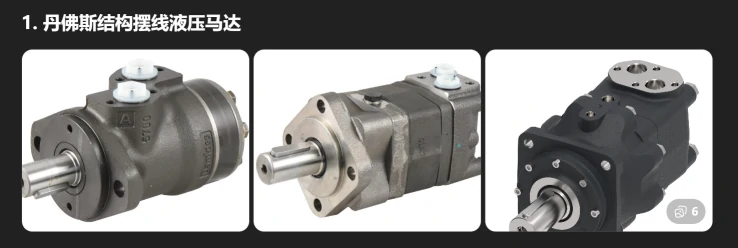
Appearance Characteristics (Danfoss)
The motor housing is usually made of gray-black or dark-colored cast iron/steel. The overall shape looks solid and heavy, with a “block-like” appearance.
The output shaft end typically features a large spline or keyway. The flange mounting face is relatively standardized and often has clear engraved markings or brand identification.
The inlet and outlet port positions, as well as the drain / back-pressure ports, are usually designed in a neat and symmetrical layout. The valve plate (distributor) structure is hidden inside the housing, so no large external valve plate is visible from the outside.
Common models such as the OMP, OMT, and OMV series appear, in terms of proportions, to have larger shaft diameters, spline sizes, and flange thicknesses, giving a clear impression of “heavy-duty,” “high torque,” and “low speed.”
Overall, the structure has a strong “industrial” feel: robust, thick-walled, with large flanges and solid support.
Eaton/Char-Lynn type:
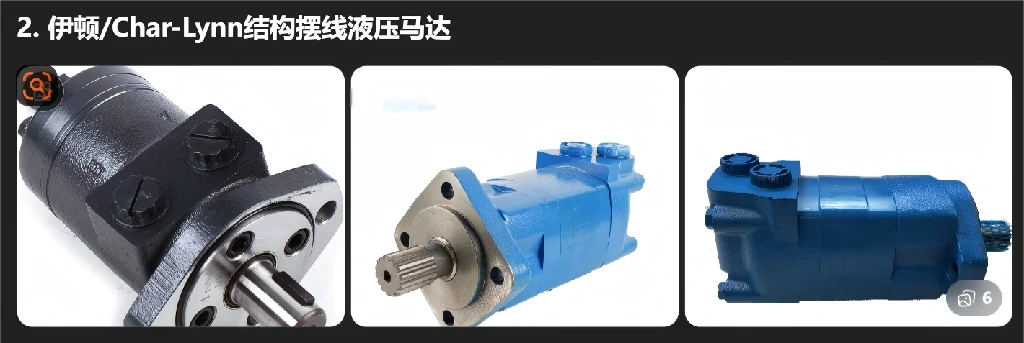
External Appearance Characteristics (Eaton/Char-Lynn)
The motor housing is often blue or blue-gray, which is a typical color scheme for many Char-Lynn series products (although other colors may also be used).
The flange and shaft-end designs are diverse, including straight shafts, splines, and keyed shafts. Compared with Danfoss, they sometimes give a more “compact” and “modular” impression.
Although the valve distribution structure (gerotor or valve-drive shaft) is hidden inside, the overall body proportions may appear slightly more “elongated” or “cylindrical,” rather than very thick and block-like.
The oil ports and back-pressure (case drain) connections are clearly arranged, but from an external view there may be more “protruding ports” or versions with significant size variations, due to the wide range of available series.