.png)
.png)
.png)

Expert Guide: How Does a Hydraulic Orbital Motor Work in 4 Key Steps?
Ноябрь 13, 2025
Аннотация
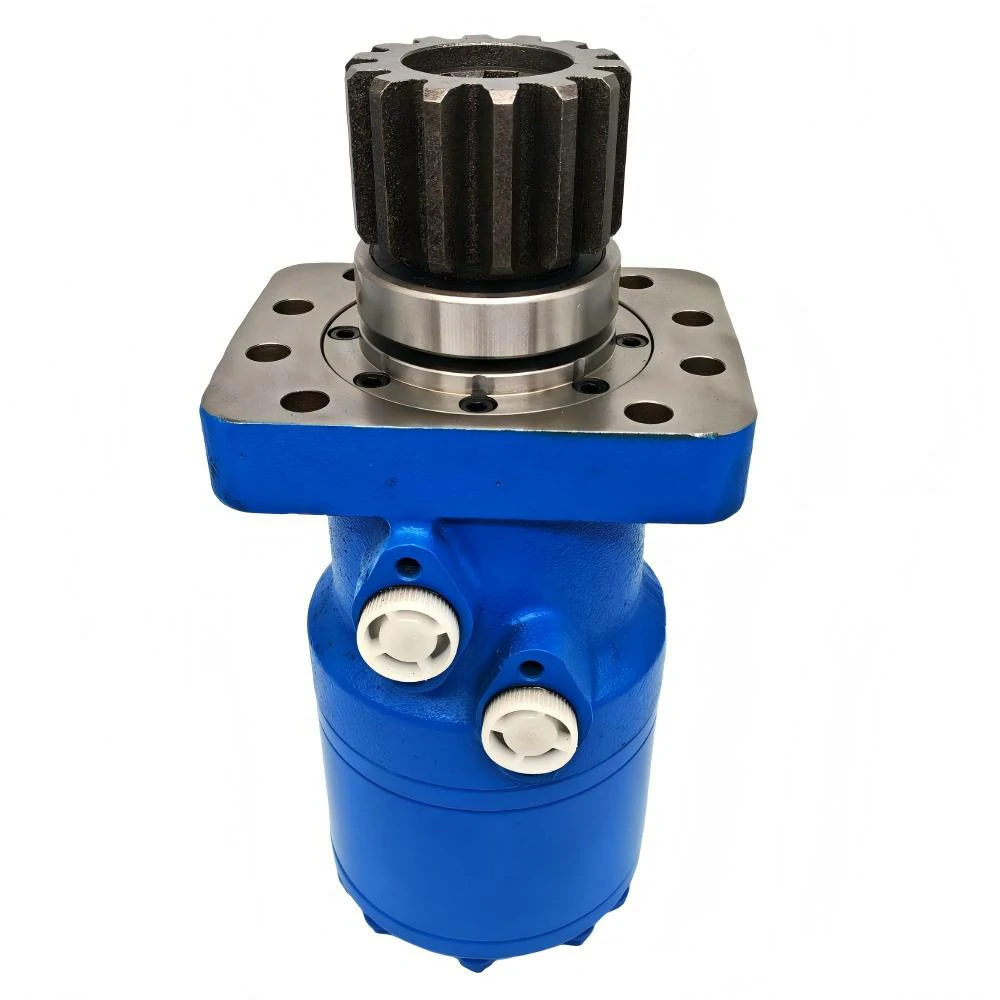
The hydraulic orbital motor operates on the principle of converting fluid pressure into mechanical rotational force through an internal gear mechanism. Central to its function is the Gerotor set, comprising a fixed external gear (stator) and a moving internal gear (rotor) with a differential tooth count. Pressurized hydraulic fluid, supplied by a source like an electric hydraulic pump, is directed into the motor through a commutator or valve. This fluid fills expanding volume chambers created by the eccentric meshing of the rotor and stator. The resulting pressure differential across the rotor forces it to orbit within the stator. This orbital motion is then translated into a concentric, high-torque, low-speed rotation of the output shaft via a specialized driveshaft. The de-pressurized fluid is simultaneously expelled from contracting chambers and returned to the system reservoir. This continuous cycle allows the motor to produce significant torque from a compact and efficient design, making it a cornerstone in various industrial and mobile applications.
Основные выводы
- Pressurized fluid creates a force differential within the Gerotor set, initiating motion.
- The rotor orbits within the stator, driven by the sequential filling of sealed chambers.
- A driveshaft converts the rotor's eccentric orbit into smooth output shaft rotation.
- Understanding how a hydraulic orbital motor work reveals its high-torque, low-speed nature.
- Proper fluid maintenance is paramount for the longevity and efficiency of the motor.
- The design's core is the Gerotor set, with its unique cycloidal gear profile.
Оглавление
- A Foundational Look at Hydraulic Power
- Step 1: The Ingress of Power – Fluid Pressurization and Directed Flow
- Step 2: The Heart of the Machine – The Gerotor Set and Motion Generation
- Step 3: From Orbit to Output – Translating Motion into Usable Torque
- Step 4: Completing the Circuit – Fluid Exhaust and the Continuous Cycle
- Distinguishing Features: Key Types of Orbital Motors
- Performance Metrics and Intelligent Selection
- Global Impact: Applications of Orbit Hydraulic Motors
- Sustaining Power: Maintenance and Troubleshooting
- Часто задаваемые вопросы
- A Concluding Thought on Mechanical Elegance
- Ссылки
A Foundational Look at Hydraulic Power
Before we can fully appreciate the intricate dance of gears and fluid within an orbital motor, it is necessary to first grasp the fundamental principles that give it life. The entire field of hydraulics is built upon a simple yet profound observation about the nature of fluids. Imagine you have a container filled with water. If you apply pressure to any single point on that water's surface, that pressure is not confined to that spot. Instead, it is transmitted equally and undiminished to every other point within the water and to the walls of the container itself. This is the essence of Pascal's Law, a principle formulated by the French mathematician and physicist Blaise Pascal in the 17th century. It is this transmission of force through an incompressible fluid that forms the bedrock of every hydraulic system, from the brakes in your car to the massive arms of a construction excavator.
A hydraulic system, in its simplest form, acts as a force multiplier. It takes an input force and, by channeling fluid, transforms it into a much larger output force. The primary components of such a system are a reservoir to hold the hydraulic fluid (typically a specialized oil), a pump to create fluid flow, valves to direct that flow, and an actuator to convert the fluid energy back into mechanical work. This actuator can be a linear one, like a hydraulic cylinder that pushes and pulls, or a rotary one, which is where our subject, the hydraulic motor, comes into play (Eng.libretexts.org, 2025). The pump does not create pressure; rather, it creates flow. Pressure arises when that flow meets resistance, such as the internal components of a motor.
The Source of Flow: The Electric Hydraulic Pump
The motive force for nearly all modern industrial hydraulic systems is the pump. While some may be driven by internal combustion engines, a vast number are powered by electric motors, creating what we call an electric hydraulic pump. This device is the heart of the system, drawing fluid from the reservoir and pushing it into the circuit. It is a converter of energy, transforming the electrical energy that powers its motor into the kinetic energy of moving fluid. There are various types of pumps—gear pumps, vane pumps, and piston pumps—each with its own characteristics regarding pressure capabilities and flow consistency. The choice of pump is a critical design decision, as it dictates the potential power and speed available to the actuators downstream. The electric hydraulic pump provides the steady, reliable stream of fluid that is the lifeblood of the motor, waiting to be converted into torque.
Pumps vs. Motors: A Tale of Two Functions
It is a common point of initial confusion to see a hydraulic pump and a hydraulic motor and assume they are interchangeable. Structurally, they can appear remarkably similar. A gear pump and a gear motor, for instance, both contain a set of meshing gears inside a housing. The fundamental difference lies in their function and the direction of energy conversion. A pump, as we have seen, takes mechanical rotation as an input (from an electric motor or engine) and converts it into fluid flow as an output. It drives the fluid. A hydraulic motor, conversely, takes fluid flow as its input and converts it into mechanical rotation—torque and speed—as its output. The fluid drives the motor.
Think of it like an electric fan and a wind turbine. A fan uses electrical energy to turn its blades and create a flow of air. A wind turbine uses the flow of air to turn its blades and create electrical energy. They are two sides of the same coin, one driving the medium and the other being driven by it. So it is with hydraulic pumps and motors. The pump generates the "wind" of hydraulic fluid, and the motor acts as the "turbine," harnessing that flow to do useful work (Hidraoil.com, 2023). Our focus, the orbital motor, is a particularly elegant and effective type of rotary actuator, a specialized "turbine" designed for specific kinds of work.
Step 1: The Ingress of Power – Fluid Pressurization and Directed Flow
The journey of power within a hydraulic orbital motor begins not within the motor itself, but far upstream at the pump. The electric hydraulic pump pressurizes the hydraulic fluid, imbuing it with potential energy. This pressurized fluid travels through hoses and tubes until it reaches the motor's inlet port. This is the gateway. The first action in understanding how a hydraulic orbital motor works is to trace the path of this high-pressure fluid as it enters the motor housing, poised to begin its work.
The pressure of the fluid is a measure of the force it can exert per unit of area. The flow rate, measured in liters per minute or gallons per minute, determines the potential speed of the motor. The combination of pressure and flow defines the total hydraulic horsepower available. Upon reaching the motor, this stream of energized fluid does not simply flood the entire internal cavity. It must be precisely controlled and directed to specific locations at specific times. This critical task of distribution falls to a component known as the commutator or, in some designs, a distributor valve.
The Distributor Valve: The Traffic Controller
Imagine a revolving door with multiple compartments. The distributor valve functions in a similar way, acting as a sophisticated traffic controller for the hydraulic fluid. It is a precisely machined plate or cylinder with a series of passages that align with the ports of the motor's power section—the Gerotor set. As the motor rotates, the distributor valve rotates in sync (or is timed to it), continuously opening a path for high-pressure inlet fluid to enter the correct chambers while simultaneously opening a path for low-pressure exhaust fluid to leave other chambers.
This component is the brain of the fluid-to-mechanical interface. Without it, the fluid pressure would be applied equally to all internal parts, resulting in a hydraulic lock with no net force to produce rotation. The distributor valve ensures that pressure is always applied where it can do the most work—in the chambers that are expanding in volume—and that fluid is allowed to escape from the chambers that are contracting. The timing and precision of this valving action are paramount to the motor's smooth operation and efficiency. Different motor designs utilize different valve types, such as spool valves or disc valves, each with its own advantages in terms of flow capacity, pressure handling, and internal leakage.
| Характеристика | Spool Valve Orbital Motor | Disc Valve Orbital Motor |
|---|---|---|
| Valve Design | A cylindrical "spool" with lands and grooves slides or rotates to direct flow. | A flat, rotating disc with kidney-shaped ports aligns with passages. |
| Flow Path | Typically longer and more complex, which can lead to higher pressure drops. | Shorter and more direct flow path, generally leading to lower pressure drops. |
| Эффективность | Can have slightly lower volumetric efficiency due to the longer sealing paths of the spool. | Often offers higher volumetric and overall efficiency due to better sealing and flow. |
| Timing | Timing is controlled by the connection between the spool and the main shaft. | The disc valve is directly driven by the driveshaft, ensuring perfect timing with the Gerotor. |
| Общее использование | General-purpose applications, often found in older or less demanding designs. | High-performance applications where efficiency and smooth low-speed operation are key. |
The Nature of the Working Fluid
We speak of "hydraulic fluid," but it is worth a moment to consider what this substance is and why its properties are so important. It is far more than just an oil. A high-quality hydraulic fluid is a complex formulation designed to perform several jobs at once. Its primary role is to transmit power, which requires it to be nearly incompressible. It must also lubricate the myriad moving parts within the pump and motor, reducing wear and friction. Think of the tight tolerances between the rotor and stator in an orbital motor; without a lubricating film, they would quickly gall and seize.
Furthermore, the fluid must carry heat away from working components and transport it to a reservoir or cooler where it can be dissipated. It also contains additives to prevent rust, corrosion, and the formation of foam, which could introduce compressibility into the system and make it feel "spongy." The viscosity of the fluid—its resistance to flow—is a delicate balance. Too thick, and it creates excessive friction and is hard to pump. Too thin, and it may not provide an adequate lubricating film at high temperatures. Maintaining the cleanliness and integrity of this fluid is the single most important aspect of hydraulic system maintenance. Contaminants act like an abrasive, rapidly wearing down the precision-machined internal surfaces and destroying the motor from the inside out.
Step 2: The Heart of the Machine – The Gerotor Set and Motion Generation
We have followed the pressurized fluid through the inlet port and past the distributor valve. Now it arrives at the very heart of the motor, the component set that performs the magical conversion of fluid pressure into mechanical motion. This is the Gerotor set. The name itself is a portmanteau of "Generated Rotor," which hints at its unique geometry (Ato.com, 2025). This mechanism is the defining feature of all орбитальные гидромоторы and is the key to understanding their remarkable ability to produce high torque at low speeds.
The Gerotor set consists of two primary parts: a stationary outer ring gear, called the stator, and an internally meshing moving gear, called the rotor. The stator has a set of internal lobes, which are smooth, curved teeth. The rotor, which fits inside the stator, has a set of external teeth, also with a specific curved profile. The critical design element is that the rotor always has one fewer tooth than the stator. For example, a common configuration is a stator with seven lobes (N) and a rotor with six teeth (N-1).
The Geometry of Motion: An Eccentric Dance
Because the rotor has fewer teeth than the stator, its center is not a fixed point. As the rotor turns, its center follows a small circular path relative to the center of the stator. It orbits. This is the origin of the motor's name. Think of the Earth orbiting the Sun. The Earth is spinning on its own axis while also revolving around a central point. The rotor in an orbital motor does something similar; it both rotates on its own center and orbits around the stator's center.
This eccentric arrangement means that as the rotor turns within the stator, the teeth of the two parts are constantly meshing and unmeshing in a specific sequence. As they do, they form a series of sealed, continuously changing volume chambers between the rotor teeth and the stator lobes. At any given moment, some of these chambers are expanding in volume, while others are contracting. It is this dynamic creation of expanding and contracting chambers that the distributor valve exploits.
How Pressure Creates Force
Let us visualize the process. The distributor valve directs the high-pressure inlet fluid into the chambers that are currently growing in size. The fluid pushes against the surfaces of both the stator and the rotor in that chamber. Because the stator is fixed to the motor housing, it cannot move. The rotor, however, is free to move. The pressure acting on the face of the rotor tooth creates a force.
Now, consider the chambers on the opposite side of the Gerotor set. At the same time, the distributor valve is connecting these chambers—which are contracting in volume—to the low-pressure outlet port. This allows the fluid that has already done its work to be pushed out of the motor. The result is a significant pressure differential across the rotor. On one side, you have high-pressure fluid pushing on the rotor teeth. On the other side, you have low-pressure fluid offering little resistance. This imbalance of forces is what compels the rotor to move. It is not just pushed; it is pushed into the path of least resistance, which is the continuous rolling or orbiting motion within the stator. The force is applied over the entire surface area of the tooth, and it is this large area that begins to explain the motor's high torque output. The rotor is effectively "rolled" around the inside of the stator by the hydraulic pressure, like a coin rolling around the inside of a funnel.
Gerotor vs. Geroler™: An Evolutionary Step
A key innovation in orbital motor design was the introduction of rollers. In a standard Gerotor set, the tips of the rotor teeth make direct, sliding contact with the lobes of the stator. While effective, this creates friction, which generates heat and represents an energy loss. The Geroler™ design, a name trademarked by the Eaton Corporation but now used more generally, improves upon this by placing cylindrical rollers into the pockets of the stator.
In this configuration, the rotor teeth do not slide against the stator. Instead, they press against these rollers, which are free to turn. The contact becomes rolling friction instead of sliding friction. As anyone who has ever tried to push a heavy box versus pulling it on a wheeled cart knows, rolling friction is significantly lower than sliding friction. This seemingly small change has a profound impact. It reduces wear, lowers heat generation, and increases the mechanical efficiency of the motor, especially at startup (low speed) and under high pressure. This allows the motor to produce smoother torque and last longer, making it the preferred choice for most modern, demanding applications.
Step 3: From Orbit to Output – Translating Motion into Usable Torque
We have established how hydraulic pressure forces the rotor to perform its characteristic orbital dance within the stator. This motion, however, is complex. The center of the rotor is moving in a circle, and the rotor itself is rotating slowly relative to its own center. This is not yet the simple, usable rotation we need to turn a wheel or a winch drum. The next step in understanding how a hydraulic orbital motor works is to see how this complex orbital motion is converted into the pure, concentric rotation of the output shaft. This is the job of the driveshaft, often called a splined shaft or, colloquially, a "dog bone."
The driveshaft is a short, robust shaft with splines (a series of ridges or teeth) on both ends. One end engages with matching internal splines in the center of the rotor. The other end engages with internal splines in the output shaft of the motor. The output shaft is the part of the motor that extends outside the housing and connects to the load. Unlike the rotor, the output shaft is mounted in bearings that constrain it to rotate perfectly around a fixed, central axis.
The Ingenious Coupling
The driveshaft acts as a clever mechanical linkage that decouples the eccentricity of the rotor from the output shaft. As the rotor orbits, the driveshaft's splines allow it to accommodate the rotor's shifting center. The shaft effectively "wobbles" along with the rotor's orbit. However, because its other end is firmly engaged with the concentrically fixed output shaft, it can only transmit the rotational component of the rotor's motion. It filters out the orbital component.
Imagine holding a pencil loosely in your fist. If you move your fist in a small circle (the orbit), while also slowly twisting the pencil (the rotation), a gear attached to the end of the pencil would turn. The driveshaft performs a similar function, but with much greater precision and strength. It takes the combined orbit-plus-rotation of the rotor and transmits only the rotation to the output shaft, resulting in a smooth, continuous turning motion.
The Genesis of High Torque
The defining characteristic of an orbital motor is its ability to produce very high torque at relatively low speeds. This is why they are often categorized as Low-Speed, High-Torque (LSHT) motors. The "high torque" aspect is a direct consequence of the motor's internal geometry and the principles of hydraulics.
Torque is rotational force. It is calculated as force multiplied by the distance from the center of rotation at which that force is applied (the lever arm). In the orbital motor, the hydraulic pressure acts over the large surface area of the rotor teeth. This generates a very large force. This force is then applied at a certain distance from the center of the stator, creating the initial rotational impetus.
More importantly, the internal gearing itself provides a significant gear reduction. For every single rotation of the output shaft, the rotor must complete multiple orbits inside the stator. The exact ratio depends on the number of teeth. For our example of a 6-tooth rotor and a 7-lobe stator, the output shaft rotates 1/6th of a revolution for every full orbit of the rotor. This means the output speed is significantly reduced compared to the speed of the orbiting rotor, and just as with a set of mechanical gears, when you reduce speed, you multiply torque. The orbital motor has this large gear reduction built directly into its power-generating mechanism. It is like having a powerful engine and a heavy-duty gearbox all in one compact package. This is what allows a motor that can fit in your hand to turn the heavy auger on a piece of farm equipment.
| Параметр | High-Speed, Low-Torque (HSLT) Motor (e.g., Gear Motor) | Low-Speed, High-Torque (LSHT) Motor (e.g., Orbital Motor) |
|---|---|---|
| Типичный диапазон скоростей | 500 – 5000+ RPM | 0 – 1000 RPM (often much lower) |
| Torque Output | Low to moderate. | Very high, especially relative to its size. |
| Internal Gearing | Minimal or no internal gear reduction. | Significant inherent gear reduction from the Gerotor principle. |
| Size & Weight | Can be compact, but requires external gearing for high-torque tasks. | Very compact and power-dense for the torque produced. |
| Общие приложения | Fan drives, auxiliary functions, power steering pumps. | Conveyor belts, agricultural machinery, winches, wheel drives. |
| Operating Principle | Direct fluid push on gears or vanes with high rotational speed. | Fluid pressure creates a large force with high leverage and gear reduction. |
Step 4: Completing the Circuit – Fluid Exhaust and the Continuous Cycle
The process of generating torque is not a one-time event; it is a continuous, cyclical flow of energy. For the motor to keep turning, the fluid that has expended its energy must be efficiently removed to make way for the next charge of high-pressure fluid. This final step closes the loop and is just as critical as the power-generating phase. The entire operation relies on a constant, uninterrupted cycle of fluid entering, working, and exiting.
As we saw, the distributor valve directs high-pressure fluid to the expanding chambers of the Gerotor set. Simultaneously, the rotor's motion is causing the chambers on the opposite side to decrease in volume. The fluid trapped in these contracting chambers must go somewhere. The same distributor valve that controls the inlet flow also provides the escape route. Its precisely timed rotation opens a path from these contracting chambers to the motor's outlet port.
The Gentle Push Outward
The fluid in the contracting chambers is now at a much lower pressure, having transferred most of its energy to the rotor. It does not exit under its own power; rather, it is gently but firmly displaced by the mechanical action of the chamber shrinking. The rotor, driven by the high pressure on the other side, effectively squeezes the spent fluid out into the outlet passage. This ensures that the chambers are empty and ready to receive a new charge of high-pressure fluid when they cycle back around to the inlet side.
This coordinated action of filling and emptying is what allows for smooth, continuous rotation. If the exhaust fluid were not removed efficiently, pressure would build up in the contracting chambers, creating a back-pressure that would oppose the motor's rotation. This would dramatically reduce the net torque output and lower the overall efficiency of the motor. The design of the outlet passages and the distributor valve is therefore optimized to present as little resistance as possible to the outgoing flow.
Return to the Reservoir
Once the low-pressure fluid passes through the outlet port, it travels through return lines back to the hydraulic reservoir. The reservoir is more than just a holding tank. It gives the fluid a chance to cool down, as the heat absorbed from the motor and pump is dissipated through the tank's walls or a dedicated heat exchanger (cooler). It also allows any air bubbles that may have entered the system to rise to the surface and escape. Finally, it provides a place for contaminants and debris to settle at the bottom, away from the pump's suction line, where they can be captured by filters.
From the reservoir, the cooled, clean fluid is drawn back into the suction side of the electric hydraulic pump, where it is re-pressurized, and the entire cycle begins anew. A single drop of hydraulic fluid might make this circuit—from pump to motor and back again—thousands of times in its service life, each time carrying a parcel of energy to be converted into useful mechanical work. The integrity of this closed loop is fundamental to the reliability and longevity of the entire hydraulic system. Any leaks, both external (dripping oil) and internal (fluid bypassing seals inside the motor), represent a loss of energy and a reduction in performance.
Distinguishing Features: Key Types of Orbital Motors
While all orbital motors operate on the same fundamental Gerotor principle, they are not a monolithic category. Engineers have developed several variations to optimize performance for different applications, pressures, and flow rates. The most significant distinctions lie in the design of the distributor valve and the interface between the rotor and stator. Understanding these differences is key to selecting the right motor for a specific task. The two primary valve designs are the spool valve and the disc valve.
Spool Valve Design
In a spool valve orbital motor, the distribution of fluid is controlled by a cylindrical spool that rotates in sync with the main shaft. The spool has a series of grooves and lands (the raised sections between grooves) machined into it. As it turns, these grooves and lands align with ports in the motor housing, directing high-pressure fluid to the appropriate Gerotor chambers and venting low-pressure fluid. This design is robust and was common in earlier generations of orbital motors. However, the fluid must often travel a relatively long and winding path to get from the spool to the Gerotor set. This can create a pressure drop, which is a form of energy loss, slightly reducing the motor's overall efficiency.
Disc Valve Design
A more modern and generally more efficient design is the disc valve motor. In this configuration, the spool is replaced by a flat, rotating disc that sits directly against the Gerotor set. The disc has kidney-shaped ports machined into it. This valve disc is driven by the same driveshaft that turns the output shaft, ensuring perfect timing. As it rotates, its ports slide over corresponding openings in the stationary end plate of the Gerotor, distributing the fluid.
The primary advantage of the disc valve is that it provides a much shorter, more direct path for the fluid. This minimizes the pressure drop and improves volumetric efficiency, which is a measure of how effectively the motor converts fluid flow into rotation without internal leakage. The improved fluid dynamics and better sealing of the disc valve design typically result in higher overall efficiency, smoother operation at very low speeds, and a longer service life, particularly in high-pressure applications. For these reasons, disc valve motors have become the standard for many demanding industrial and mobile hydraulic systems.
Performance Metrics and Intelligent Selection
Choosing the correct hydraulic motor for an application is a critical engineering decision that goes beyond simply knowing how it works. It requires a careful evaluation of several key performance parameters to ensure the motor can meet the demands of the job reliably and efficiently. Matching the motor's capabilities to the load's requirements is essential for system performance, longevity, and safety. A prospective buyer must consider displacement, torque rating, speed, pressure, and efficiency.
Перемещение
Displacement is perhaps the most fundamental specification of any hydraulic motor. It is the theoretical volume of fluid that the motor will accept to turn its output shaft through one full revolution. It is typically measured in cubic centimeters per revolution (cc/rev) or cubic inches per revolution (in³/rev). A motor with a larger displacement will require more fluid to turn once, but it will also produce more torque for a given pressure. A smaller displacement motor will spin faster for a given flow rate but will produce less torque. Displacement is the primary factor in determining the relationship between flow rate and speed, and between pressure and torque.
Torque and Speed
Torque is the rotational force the motor can produce and is the main reason for selecting an LSHT motor like an orbital. It is rated in Newton-meters (Nm) or pound-feet (lb-ft). The theoretical torque of a motor is directly proportional to its displacement and the system's working pressure. The actual torque available at the shaft will be slightly less due to mechanical friction. Speed, measured in revolutions per minute (RPM), is directly proportional to the flow rate of fluid supplied to the motor and inversely proportional to the motor's displacement. A key consideration is the motor's minimum and maximum continuous speed rating, as well as its ability to operate smoothly and without "cogging" at the very low end of its speed range.
Pressure and Efficiency
Pressure ratings indicate the maximum fluid pressure the motor is designed to handle. There is typically a continuous pressure rating for normal operation, an intermittent rating for short-term peaks, and a peak rating that should never be exceeded. Operating above the continuous rating can drastically reduce the motor's lifespan.
Efficiency is a measure of how well the motor converts hydraulic power into mechanical power. It is broken down into two main components. Volumetric efficiency describes how well the motor prevents internal leakage; a motor with 95% volumetric efficiency means that 5% of the fluid supplied to it leaks past the internal seals without producing work. Mechanical efficiency describes the energy lost to internal friction. The product of these two is the overall efficiency, which is a critical factor in system design, as it impacts heat generation and energy consumption. High-quality гидравлические моторы often boast overall efficiencies well above 90%.
Global Impact: Applications of Orbit Hydraulic Motors
The unique combination of compact size, high torque, and low speed has made the orbital motor an indispensable component in a vast array of machinery across the globe. Their robust and simple design makes them particularly well-suited for the demanding environments often found in target markets like South America, Russia, Southeast Asia, the Middle East, and South Africa.
In agriculture, these motors are the workhorses behind the rotation of augers on seeders and combines, the turning of conveyor belts on harvesters, and the drive systems for sprayers. Their ability to deliver precise, high-torque motion is perfect for these tasks. In Russia's vast farmlands or Brazil's extensive soy plantations, the reliability of these motors is paramount during short planting and harvesting seasons.
The construction industry relies heavily on orbital motors. They power the wheel drives on skid-steer loaders, giving them their characteristic agility and pushing power. They turn the drums on small concrete mixers, drive sweepers and attachments, and provide the slewing (rotating) function for small cranes and aerial work platforms. In the rapidly developing urban centers of Southeast Asia and the Middle East, the compact power of these motors is essential for machinery operating in tight spaces.
In the marine sector, they are used to power winches, capstans, and steering systems on fishing vessels and workboats. Their sealed design and robust construction stand up well to the harsh, corrosive saltwater environment, a common challenge from the coasts of South Africa to the archipelagos of Indonesia.
Manufacturing and material handling industries use orbital motors to drive conveyor systems, power industrial mixers, and position heavy components with precision. Their smooth, controllable low-speed operation is ideal for applications where steady, powerful movement is required. The ability to start and stop smoothly under full load makes them superior to many electric motor and gearbox combinations for these types of tasks.
Sustaining Power: Maintenance and Troubleshooting
A hydraulic orbital motor is a marvel of robust engineering, but it is not invincible. Its longevity and performance are directly tied to the health of the hydraulic system as a whole, and proper maintenance is not merely recommended; it is obligatory for reliable operation. The overwhelming majority of premature motor failures can be traced back to a single culprit: contaminated hydraulic fluid.
The Primacy of Fluid Health
As discussed, hydraulic fluid is the lifeblood of the system. If that blood becomes contaminated with dirt, water, or metal particles, it turns from a lubricant into a liquid grinding compound. These contaminants are carried at high velocity through the motor, where they erode the precision-machined surfaces of the Gerotor set, the distributor valve, and the driveshaft. This wear opens up the tight internal clearances, leading to increased internal leakage. The motor loses volumetric efficiency, meaning it gets weaker and slower. The contamination can also clog small orifices, leading to erratic operation, and can damage seals, causing external leaks.
A rigorous maintenance schedule should include regular fluid sampling and analysis to check for contamination and degradation of the fluid's properties. Filters must be changed according to the manufacturer's recommendations, or sooner if the system operates in a particularly dirty environment. The reservoir should be kept clean, and care must be taken to prevent contaminants from entering the system whenever it is opened for service.
Common Failure Modes and Diagnosis
When a motor begins to fail, it will usually provide warning signs. A gradual loss of power or speed can indicate increasing internal leakage due to wear. Jerky or erratic operation might point to contamination in the distributor valve or excessive wear in the driveshaft splines. A sudden increase in operating temperature can signal high internal friction or problems with system cooling. New or unusual noises, such as whining or grinding, are immediate red flags that indicate severe internal distress, and the system should be shut down to prevent catastrophic failure.
Troubleshooting a faulty motor often involves isolating it from the rest of the system. By measuring the flow and pressure going into the motor and comparing the output speed and torque to its specifications, a technician can determine if the motor itself is at fault or if the problem lies elsewhere, such as with the pump or a control valve. A case drain flow measurement is a particularly useful diagnostic tool. The case drain line is a low-pressure line that carries away the normal internal leakage fluid. A significant increase in the flow from this line is a direct indication that the motor's internal clearances have worn excessively and it is nearing the end of its service life.
Часто задаваемые вопросы
What is the main difference between an orbital motor and a standard gear motor?
The primary difference lies in their operating principle and performance characteristics. A standard gear motor uses two externally meshing gears to produce rotation. It operates at high speeds with relatively low torque. An orbital motor uses an internal gear (rotor) orbiting within an external gear (stator), a design that creates a large, inherent gear reduction. This allows it to operate at very low speeds while producing very high torque, making it a Low-Speed, High-Torque (LSHT) device.
Why is it specifically called an "orbital" motor?
The name comes from the unique motion of the internal rotor. Because the rotor has one fewer tooth than the stationary stator, its center cannot remain fixed. As it is pushed around by hydraulic pressure, the center of the rotor follows a small circular path—it "orbits"—around the center of the stator. This orbital motion is then converted into pure rotation at the output shaft.
Can hydraulic orbital motors be run in reverse?
Yes, most orbital motors are bidirectional. By simply reversing the direction of fluid flow—making the outlet port the inlet and vice versa—the motor's output shaft will rotate in the opposite direction. This is a common feature used in applications like wheel drives and winches, where both forward and reverse motion are required.
What is the most common cause of orbital motor failure?
By a wide margin, the most common cause of failure is hydraulic fluid contamination. Dirt, water, and metal particles in the fluid act as an abrasive, wearing down the precision internal components. This leads to increased internal leakage, loss of performance, and eventual seizure. Proper filtration and fluid maintenance are the best ways to prevent premature failure.
How do I determine the right size orbital motor for my application?
Sizing an orbital motor requires knowing the torque and speed requirements of the load you need to drive. First, determine the maximum torque needed to move the load. Then, using the system's available hydraulic pressure, you can calculate the required motor displacement. Next, determine the required speed of rotation. Using the motor's displacement, you can calculate the fluid flow rate your pump will need to provide to achieve that speed. It is always wise to consult manufacturer specifications and consider a safety margin.
What is a "Geroler™" and how is it different from a "Gerotor"?
Both are the core power-generating element of an orbital motor. A "Gerotor" features a rotor with teeth that make direct, sliding contact with the lobes of the stator. A "Geroler™" is an enhancement of this design where rollers are placed in the pockets of the stator. The rotor teeth then make rolling contact with these rollers instead of sliding contact. This reduces friction, improves efficiency, and increases the motor's lifespan.
Can I repair a worn-out orbital motor?
Yes, many orbital motors are designed to be serviceable. Seal kits are commonly available to fix leaks. For more extensive wear, full rebuild kits containing a new Gerotor/Geroler set, driveshaft, and bearings may be available. However, the cost of a full rebuild must be weighed against the cost of a new motor, especially for smaller displacement models. The repair must be done in an extremely clean environment to prevent contamination.
A Concluding Thought on Mechanical Elegance
The hydraulic orbital motor stands as a testament to mechanical ingenuity. It solves a fundamental engineering problem—the need for high rotational force in a small package—with a solution that is both powerful and elegantly simple in its concept. By harnessing the basic laws of fluid dynamics and translating them through a unique geometric dance of orbiting gears, it delivers the muscle for a staggering variety of machines that shape our world. From tilling the soil that grows our food to building the cities we live in, the quiet, relentless work of the orbital motor is a foundational element of modern industry. Understanding the intricate journey of fluid and force within its housing is not just an academic exercise; it is an appreciation for the clever design that makes so much of our daily lives possible.
Ссылки
Ato.com. (2025). What is an orbital motor working principle? ATO. https://www.ato.com/what-is-an-orbital-motor-working-principle
Eng.libretexts.org. (2025). 7.3: Hydraulic motors – types and applications. LibreTexts Engineering. (NWTC)/07%3ABasicMotorCircuits/7.03%3AHydraulicMotors-Typesand_Applications
Hidraoil.com. (2023). Learn about hydraulic motors. Hidroil.
Kamchau.com. (2021). Understanding orbital hydraulic motors: Design, operation, and applications. Kamchau.
Parker Hannifin Corporation. (2015). Essential criteria for selecting the right motor for your hydraulic application. Parker.
Purdue University. (2025). Reference list: Basic rules. Purdue OWL.